
Not the first time I’ve seen this:
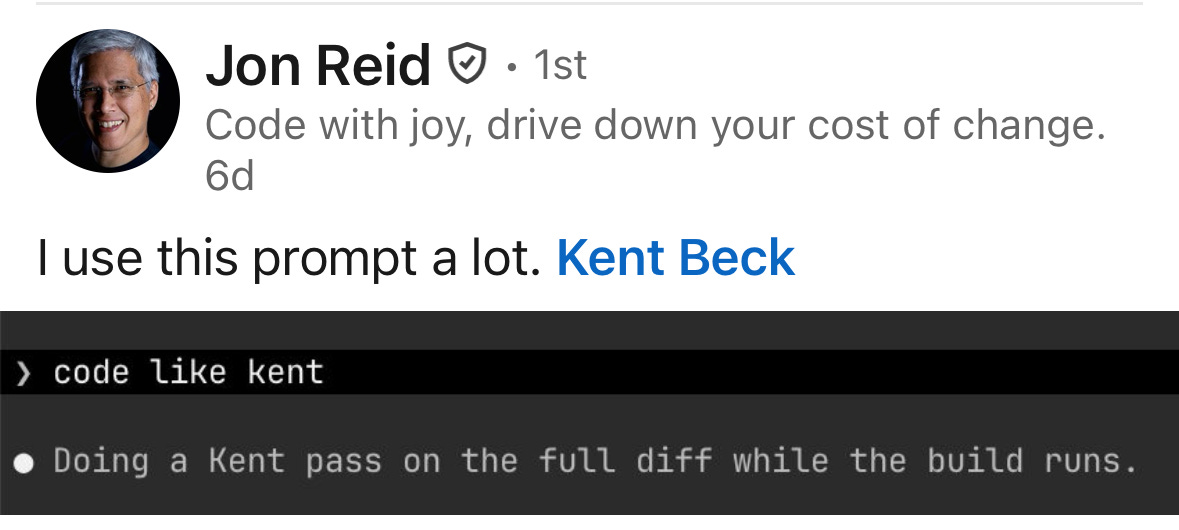
I always have a twinge of entitlement when I see it. I created some value in the world. Some of that value should come back to me, no?
That kind of thinking—create value → get paid—violates a fundamental economic principle that I’ve been noodling on, a principle that I haven’t seen anywhere else (← so likely it’s wrong, but still worth thinking about). Here’s the principle: you don’t get paid for what you’ve done, you get paid for what you’re going to do.
One Hit Wonder
Assume for the moment that an economy is a way society allocates resources to their highest & best use. (It’s also a way to create options for future highest & best uses, following Features/Futures, but that’s a thought for another day. As is the observation that economies are subject to all kinds of distortions.)
Music enriches society. Which musicians should we pay (allocate scarce music money resources to) to make music? Take the example of a one-hit wonder. They enrich society once & never will again. How much should we (society) pay them? Zero.
Yes, that strikes me as “unfair”, but we lose nothing by stiffing them. We’d rather take that same money & route it to support musicians who are going to write & perform new songs.
Second Order Effects
Not so fast. What about all the other potential one-hit wonders out there? We want their one hits in our playlist, so maybe we pay off this one-hit wonder to encourage them. We don’t want them saying, “My one hit isn’t going to net me anything so never mind.” (← interesting parallels to the wholesale ingestion of living authors’ work into LLMs.)
Another point—we can’t confidently predict that the one-hit wonder won’t produce a second, third, & fourth hit. So we (society) allocate money to them on the chance that they will give us another party rockin’ hit.
We don’t want to over-allocate resources to musicians who we don’t confidently expect to produce “valuable” music. That would result in fewer musicians & fewer hits. The starving artist is a social strategy to maximize the amount of art.
Manufacturing
Take a more predictable example—auto manufacturing. You’re running a car factory. You make a car. You sell it. You’re getting paid for the car, right? Not from this perspective.
Take the last car out of the factory. Society benefits from having one more car. However, no further cars are ever going to emerge from that factory. Society should allocate zero resources to the factory. The factory doesn’t need more steel, more labor, more rubber. That last car should be free.
From this “in advance” perspective, paying for a car is allocating steel, labor, & rubber to the next car the factory produces.
Back To My Situation
Back to “…like Kent Beck”. Should I get paid for the value people derive from my past contributions? Only if:
We (society) wants to incentivize others to contribute to the commons, or
We (society) expects me to use those resources to create new value.
If someone in the next generation says, “Oh look, Kent contributed XP & TDD & JUnit & patterns & 3X & now he’s financially secure,” maybe they’re incentivized to come up with their own ideas & circulate them. Society benefits from their ideas more than the signaling cost of paying me.
From my perspective I’m not done yet. I think I have valuable contributions to make in the Genie Era but I’m about as biased as it’s possible to be. Still, I can point to coining the term “genie”, to Features Versus Futures, to individual & group coaching that folks find valuable, I can point to those things as indications that I will contribute in the future.
Next Time
Next time I feel that entitlement feeling coming on, I’ll remind myself that I don’t get paid for what I’ve done, only for what I’m going to do. And get back to work.
Prologue
This idea of getting paid in advance struck me in 2003 while I was sitting alone on a chair lift. I’ve tried many times to write it up but always come up short. It wasn’t until it became personal that I had enough incentive to get through this essay. I’m not an economist. What are people going to say? Blah blah blah. Here it is. I hope you find it helpful.
One more thing (while you're here)

I'll be sitting down with Derek Collison (founder of Synadia, creator of NATS) for a live fireside chat on December 10 at 4:30pm ET online — AI, the craft of software, and where the value goes. Synadia's sponsoring the hour, the seat's free for you, which, given the essay above, strikes me as the system working as described.
First, let me introduce myself as a troll. A honest-ish, not particularly aggressive one.
But still, be warned.
Having said that:
Assume for the moment that an economy is a way society allocates resources to their highest & best use. (It’s also a way to create options for future highest & best uses, following Features/Futures, but that’s a thought for another day. As is the observation that economies are subject to all kinds of distortions.)
And to that I'm obligated to say How very uh Karl Marx-y of you, isn't it?
Not complaining, of course: “I’m kinda of a commie myself, you know…” What can I say, easier when you're not American (and not Polish, also not Romanian, …) I s’pose.
Anyway. He famously said, and I quote:
Jeder nach seinen Fähigkeiten, jedem nach seinen Bedürfnissen
From each according to their abilities, to each according to their needs.
I agree it sounds a bit different, but is it, really…? Even what you said about future: the future also has needs, so…
Then, of course, as a good/pretense Marxist, I must also say: the world you’re (we’re?) describing is an ideal one, but not the current one: because that's definitely not how resources are allocated in this planet, I’m afraid…!
If it were, then it would be True Communism ™️ 👻 ❤️…!
… not exactly what you and me got back at home, right?! 😅